Sound as a U.S. Dollar?
Sent: Saturday, September 15,
2018 4:44 PM
Subject: 10 Things That Every
American Should Know About The Federal Reserve
My Comments: When was the last time you heard
the phrase “sound as the U.S. Dollar”? There are a number of websites
that have dollar calculators over time, such as https://www.officialdata.org/1800-dollars-in-1913?amount=100 Play with it a bit and you
will see that between 1800 and 1913 the purchasing value of the dollar actually
increased. However, since 1913 when the Federal Reserve was established,
the purchasing value of the dollar steadily decreased by an average of 3.13% a
year. Today the dollar is worth about 2 to 3 cents of what it was worth
in 1913 and the situation is getting worse every year.
Think about it: The Federal Reserve is a
clever creation of the banking community, that steals, from an apparently
oblivious public, an average of 3.14% a year of the total worth of our money
supply each and every year.
According to Article
I, Section 8 of the U.S. Constitution, the U.S. Congress has been given the
responsibility to “coin Money, regulate the Value thereof, and of foreign Coin,
and fix the Standard of Weights and Measures”. So why is the Federal
Reserve doing it?
It is hard to get
information about the Federal Reserve. There are a lot of conspiracy
books out there about the Federal Reserve, such as The Creature from Jekyll
Island and many others.
The article below
is the best I have found thus far, and it also seems to answer a question I
have had for some time about the Federal Reserve. If our money is being
steadily devalued, who is getting the money from the inflation? As many
countries inflate their currency to pay off debt, that certainly is not the
case with the United States. Maybe the answer is in item 1 of the 10
things listed below, where the member banks are paid dividends of 6% a year.
I’d like to know for sure.
If we are to repair
this nation, the Federal Reserve seems to be one of the items that need to be
repaired. There is no reason that our government should operate its money
supply such that our dollar is devalued more than 3% a year, year after year
after year. That is theft for all those who have money in their pockets,
or banks and thrift institutions. That is not the way it averaged prior
to the creation of the Federal Reserve in 1913.
Michael Snyder
Feb 9, 2012
Share

What would happen if the Federal Reserve was shut down
permanently? That is a question that CNBC asked recently, but
unfortunately most Americans don’t really think about the Fed much. Most
Americans are content with believing that the Federal Reserve is just another
stuffy government agency that sets our interest rates and that is watching out
for the best interests of the American people. But that is not the case
at all. The truth is that the Federal Reserve is a private banking cartel
that has been designed to systematically destroy the value of our currency,
drain the wealth of the American public and enslave the federal government to
perpetually expanding debt. During this election year, the economy is the
number one issue that voters are concerned about. But instead of
endlessly blaming both political parties, the truth is that most of the blame
should be placed at the feet of the Federal Reserve. The Federal Reserve
has more power over the performance of the U.S. economy than anyone else
does. The Federal Reserve controls the money supply,
the Federal Reserve sets the interest rates and the Federal Reserve hands out
bailouts to the big banks that absolutely dwarf anything that Congress ever
did. If the American people are ever going to learn what is really going
on with our economy, then it is absolutely imperative that they get educated
about the Federal Reserve.
The following are 10 things that every American should know about
the Federal Reserve….
#1 The Federal Reserve System Is A
Privately Owned Banking Cartel
The Federal Reserve is not a government agency.
The truth is that it is a privately owned central bank. It is
owned by the banks that are members of the Federal Reserve system. We do
not know how much of the system each bank owns, because that has never been
disclosed to the American people.
The Federal Reserve openly admits that it is privately
owned. When it was defending itself against a Bloomberg request for
information under the Freedom of Information Act, the Federal Reserve stated
unequivocally in court that it was “not an agency” of the federal government
and therefore not subject to the Freedom of Information Act.
In fact, if you want to find out that the Federal Reserve system
is owned by the member banks, all you have to do is go to the Federal Reserve
website….
The twelve regional Federal Reserve Banks, which were established
by Congress as the operating arms of the nation’s central banking system, are
organized much like private corporations–possibly leading to some confusion
about “ownership.” For example, the Reserve Banks issue shares of stock to
member banks. However, owning Reserve Bank stock is quite different from owning
stock in a private company. The Reserve Banks are not operated for profit, and
ownership of a certain amount of stock is, by law, a condition of membership in
the System. The stock may not be sold, traded, or pledged as security for a
loan; dividends are, by law, 6 percent per year.
Foreign governments and foreign banks do own significant ownership
interests in the member banks that own the Federal Reserve system. So it would be accurate to say that the Federal Reserve is
partially foreign-owned.
But until the exact ownership shares of the Federal Reserve are
revealed, we will never know to what extent the Fed is foreign-owned.
#2 The Federal Reserve System Is A
Perpetual Debt Machine
As long as the Federal Reserve System exists, U.S. government debt
will continue to go up and up and up.
This runs contrary to the conventional wisdom that Democrats and
Republicans would have us believe, but unfortunately it is true.
The way our system works, whenever more money is created more debt
is created as well.
For example, whenever the U.S. government wants to spend more
money than it takes in (which happens constantly), it has to go ask the Federal
Reserve for it. The federal government gives U.S. Treasury bonds to the
Federal Reserve, and the Federal Reserve gives the U.S. government “Federal
Reserve Notes” in return. Usually this is just done electronically.
So where does the Federal Reserve get the Federal Reserve Notes?
It just creates them out of thin air.
Wouldn’t you like to be able to create money out of thin air?
Instead of issuing money directly, the U.S. government lets the
Federal Reserve create it out of thin air and then the U.S. government borrows
it.
Talk about stupid.
When this new debt is created, the amount of interest that the
U.S. government will eventually pay on that debt is not also created.
So where will that money come from?
Well, eventually the U.S. government will have to go back to the
Federal Reserve to get even more money to finance the ever
expanding debt that it has gotten itself trapped into.
It is a debt spiral that is designed to go on perpetually.
You see, the reality is that the money supply is designed to
constantly expand under the Federal Reserve system. That is why we have
all become accustomed to thinking of inflation as “normal”.
So what does the Federal Reserve do with the U.S. Treasury bonds
that it gets from the U.S. government?
Well, it sells them off to others. There are lots of people
out there that have made a ton of money by holding U.S. government debt.
In fiscal 2011, the U.S. government paid out 454 billion dollars
just in interest on the national debt.
That is 454 billion dollars that was taken out of our pockets and
put into the pockets of wealthy individuals and foreign governments around the
globe.
The truth is that our current debt-based monetary system was
designed by greedy bankers that wanted to make enormous profits by using the
Federal Reserve as a tool to create money out of thin air and lend it to the
U.S. government at interest.
And that plan is working quite well.
Most Americans today don’t understand how any of this works, but
many prominent Americans in the past did understand it.
For example, Thomas Edison was once quoted in the New York Times
as saying the following….
That is to say, under the old way any time we wish to add to the
national wealth we are compelled to add to the national debt.
Now, that is what Henry Ford wants to prevent. He thinks it is
stupid, and so do I, that for the loan of $30,000,000 of their own money the
people of the United States should be compelled to pay $66,000,000 — that is
what it amounts to, with interest. People who will not turn a shovelful of dirt
nor contribute a pound of material will collect more money from the United
States than will the people who supply the material and do the work. That is
the terrible thing about interest. In all our great bond issues the interest is
always greater than the principal. All of the great public works cost more than
twice the actual cost, on that account. Under the present system of doing business we simply add 120 to 150 per cent, to the stated
cost.
But here is the point: If our nation can issue a dollar bond, it
can issue a dollar bill. The element that makes the bond good makes the bill
good.
We should have listened to men like Edison and Ford.
But we didn’t.
And so we pay the price.
On July 1, 1914 (a few months after the Fed was created) the U.S.
national debt was 2.9 billion dollars.
Today, it is more than more than 5000 times larger.
Yes, the perpetual debt machine is working quite well, and most
Americans do not even realize what is happening.
#3 The Federal Reserve Has Destroyed More Than 96% Of The Value Of The
U.S. Dollar
Did you know that the U.S. dollar has lost 96.2 percent of its
value since 1900? Of course almost all of that
decline has happened since the Federal Reserve was created in 1913.
Because the money supply is designed to expand constantly, it is
guaranteed that all of our dollars will constantly lose value.
Inflation is a “hidden tax” that continually robs us all of our
wealth. The Federal Reserve always says that it is “committed” to
controlling inflation, but that never seems to work out so well.
And current Federal Reserve Chairman Ben Bernanke says that it is
actually a good thing to have a little bit of inflation. He plans to try
to keep the inflation rate at about 2 percent in the coming years.
So what is so bad about 2 percent? That doesn’t sound so bad,
does it?
Well, just consider the following excerpt from a recent Forbes
article….
The Federal Reserve Open Market Committee (FOMC) has made it
official: After its latest two day meeting, it
announced its goal to devalue the dollar by 33% over the next 20 years.
The debauch of the dollar will be even greater if the Fed exceeds its goal of a
2 percent per year increase in the price level.
#4 The Federal Reserve Can Bail Out Whoever It Wants To With No Accountability
The American people got so upset about the bailouts that Congress
gave to the Wall Street banks and to the big automakers, but did you know that
the biggest bailouts of all were given out by the Federal Reserve?
Thanks to a very limited audit of the Federal Reserve that
Congress approved a while back, we learned that the Fed made trillions of
dollars in secret bailout loans to the big Wall Street banks during the last
financial crisis. They even secretly loaned out hundreds of billions of
dollars to foreign banks.
According to the results of the limited Fed audit mentioned above,
a total of $16.1 trillion in secret loans were made by the Federal Reserve
between December 1, 2007 and July 21, 2010.
The following is a list of loan recipients that was taken directly
from page 131of the audit report….
Citigroup – $2.513 trillion
Morgan Stanley – $2.041 trillion
Merrill Lynch – $1.949 trillion
Bank of America – $1.344 trillion
Barclays PLC – $868 billion
Bear Sterns – $853 billion
Goldman Sachs – $814 billion
Royal Bank of Scotland – $541 billion
JP Morgan Chase – $391 billion
Deutsche Bank – $354 billion
UBS – $287 billion
Credit Suisse – $262 billion
Lehman Brothers – $183 billion
Bank of Scotland – $181 billion
BNP Paribas – $175 billion
Wells Fargo – $159 billion
Dexia – $159 billion
Wachovia – $142 billion
Dresdner Bank – $135 billion
Societe Generale – $124 billion
“All Other Borrowers” – $2.639 trillion
So why haven’t we heard more about this?
This is scandalous.
In addition, it turns out that the Fed paid enormous sums of money
to the big Wall Street banks to help “administer” these nearly interest-free
loans….
Not only did the Federal Reserve give 16.1 trillion dollars in
nearly interest-free loans to the “too big to fail” banks, the Fed also paid
them over 600 million dollars to help run the emergency lending program.
According to the GAO, the Federal Reserve shelled out an astounding $659.4
million in “fees” to the very financial institutions which caused the financial
crisis in the first place.
Does reading that make you angry?
It should.
#5 The Federal Reserve Is Paying Banks Not To
Lend Money
Did you know that the Federal Reserve is actually paying banks not
to make loans?
It is true.
Section 128 of the Emergency Economic Stabilization Act of 2008
allows the Federal Reserve to pay interest on “excess reserves” that U.S. banks
park at the Fed.
So the banks can just send their cash to the Fed and watch the money
come rolling in risk-free.
So are many banks taking advantage of this?
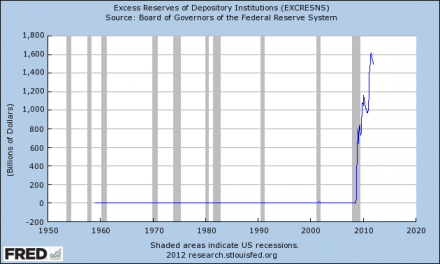
You tell me. Just check out the chart below. The
amount of “excess reserves” parked at the Fed has gone from nearly nothing to
about 1.5 trillion dollarssince
2008….
But shouldn’t the banks be lending the money to us so that we can
start businesses and buy homes?
You would think that is how it is supposed to work.
Unfortunately, the Federal Reserve is not working for us.
The Federal Reserve is working for the big banks.
Sadly, most Americans have no idea what is going on.
Another example of this is the government debt carry trade.
Here is how it works. The Federal Reserve lends gigantic
piles of nearly interest-free cash to the big Wall Street banks, and in turn
those banks use the money to buy up huge amounts of government debt.
Since the return on government debt is higher, the banks are able to make large
profits very easily and with very little risk.
This scam was also explained in a recent article in the Guardian….
Consider this: we pretend that banks are private businesses that
should be allowed to run their own affairs. But they are the biggest scroungers
of public money of our time. Banks are lent vast sums of money by central banks
at near-zero interest. They lend that money to us or back to the government at
higher rates and rake in the difference by the billion. They don’t even have to
make clever investments to make huge profits.
That is a pretty good little scam they have got going, wouldn’t
you say?
#6 The Federal Reserve Creates Artificial Economic Bubbles That
Are Extremely Damaging
By allowing a centralized authority such as the Federal Reserve to
dictate interest rates, it creates an environment where financial bubbles can
be created very easily.
Over the past several decades, we have seen bubble after
bubble. Most of these have been the result of the Federal Reserve keeping
interest rates artificially low. If the free market had been setting
interest rates all this time, things would have never gotten so far out of
hand.
For example, the housing crash would have never been so horrific
if the Federal Reserve had not created such ideal conditions for a housing
bubble in the first place. But we allow the Fed to continue to make the
same mistakes.
Right now, the Federal Reserve continues to set interest rates
much, much lower than they should be. This is causing a tremendous
misallocation of economic resources, and there will be massive consequences for
that down the line.
#7 The Federal Reserve System Is Dominated By
The Big Wall Street Banks
Even since it was created, the Federal Reserve system has been
dominated by the big Wall Street banks.
The following is from a previous article that I did about the
Fed….
The New York representative is the only permanent member of the
Federal Open Market Committee, while other regional banks rotate in 2 and 3 year intervals. The former head of the New
York Fed, Timothy Geithner, is now U.S. Treasury Secretary. The truth is
that the Federal Reserve Bank of New York has always been the most important of
the regional Fed banks by far, and in turn the Federal Reserve Bank of New York
has always been dominated by Wall Street and the major New York banks.
#8 It Is Not An Accident That We Saw The Personal Income Tax And The Federal Reserve System Both Come Into
Existence In 1913
On February 3rd, 1913 the 16th Amendment to the U.S. Constitution
was ratified. Later that year, the United States Revenue Act of 1913
imposed a personal income tax on the American people and we have had one ever
since.
Without a personal income tax, it is hard to have a central
bank. It takes a lot of money to finance all of the government debt that
a central banking system creates.
It is no accident that the 16th Amendment was ratified in 1913 and
the Federal Reserve system was also created in 1913.
They have a symbiotic relationship and they are designed to work
together.
We could fill Congress with people that are committed to ending
this oppressive system, but so far we have chosen not
to do that.
So our children and our grandchildren will face a lifetime of debt
slavery because of us.
I am sure they will be thankful for that.
#9 The Current Federal Reserve Chairman, Ben Bernanke, Has A
Nightmarish Track Record Of Incompetence
The mainstream media portrays Federal Reserve Chairman Ben
Bernanke as a brilliant economist, but is that really the case?
Let’s go to the videotape.
The following is an extended excerpt from an article that I
published previously….
———-
In 2005, Bernanke said that we shouldn’t worry because housing
prices had never declined on a nationwide basis before and he said that he
believed that the U.S. would continue to experience close to “full employment”….
“We’ve never had a decline in house prices on a nationwide basis.
So, what I think what is more likely is that house prices will slow, maybe stabilize,
might slow consumption spending a bit. I don’t think it’s gonna
drive the economy too far from its full employment path, though.”
In 2005, Bernanke also said that he believed that derivatives were
perfectly safe and posed no danger to financial markets….
“With respect to their safety, derivatives, for the most part, are
traded among very sophisticated financial institutions and individuals who have
considerable incentive to understand them and to use them properly.”
In 2006, Bernanke said that housing prices would probably keep
rising….
“Housing markets are cooling a bit. Our expectation is that the decline
in activity or the slowing in activity will be moderate, that house prices will
probably continue to rise.”
In 2007, Bernanke insisted that there was not a problem with
subprime mortgages….
“At this juncture, however, the impact on the broader economy and
financial markets of the problems in the subprime market seems likely to be
contained. In particular, mortgages to prime borrowers and fixed-rate mortgages
to all classes of borrowers continue to perform well, with low rates of
delinquency.”
In 2008, Bernanke said that a recession was not coming….
“The Federal Reserve is not currently forecasting a recession.”
A few months before Fannie Mae and Freddie Mac collapsed, Bernanke
insisted that they were totally secure….
“The GSEs are adequately capitalized. They are in no danger of
failing.”
For many more examples that demonstrate the absolutely nightmarish
track record of Federal Reserve Chairman Ben Bernanke, please see the following
articles….
*”Say What? 30 Ben Bernanke Quotes That Are So Stupid That You Won’t
Know Whether To Laugh Or Cry”
*”Is Ben Bernanke A Liar, A Lunatic Or Is He
Just Completely And Totally Incompetent?”
But after being wrong over and over and over, Barack Obama still
nominated Ben Bernanke for another term as Chairman of the Fed.
———-
#10 The Federal Reserve Has Become Way Too Powerful
The Federal Reserve is the most undemocratic institution in
America.
The Federal Reserve has become so powerful that it is now known as
“the fourth branch of government”, but there are less checks and balances on
the Fed than there are on the other three branches.
The Federal Reserve runs the U.S. economy but it is not
accountable to the American people. We can’t vote those that run the Fed
out of office if we do not like what they do.
Yes, the president appoints those that run the Fed, but he also
knows that if he does not tread lightly he won’t get
the money from the big Wall Street banks that he needs for his next election.
Thankfully, there are a few members of Congress that are
complaining about how much power the Fed has. For example, Ron Paul once
told MSNBC that he believes that the Federal Reserve is now actually more
powerful than Congress…..
“The regulations should be on the Federal Reserve. We should have
transparency of the Federal Reserve. They can create trillions of dollars to
bail out their friends, and we don’t even have any transparency of this.
They’re more powerful than the Congress.”
As members of Congress such as Ron Paul have started to shed some
light on the activities of the Federal Reserve, that has caused many in the
mainstream media to come to the defense of the Fed.
For example, a recent CNBC article entitled “If The
Federal Reserve Is Abolished, What Then?” makes it sound like there is
absolutely no other rational alternative to having the Federal Reserve run our
economy.
But this is not what our founders intended.
The founders did not intend for a private banking cartel to issue
our money and set our interest rates for us.
According to Article I, Section 8 of the U.S. Constitution, the
U.S. Congress has been given the responsibility to “coin Money, regulate the
Value thereof, and of foreign Coin, and fix the Standard of Weights and
Measures”.
So why is the Federal Reserve doing it?
But the CNBC article mentioned above makes it sound like the sky would
fall if control of the currency was handed back over to the American people.
At one point, the article asks the following question….
“How would the U.S. economy then function? Something has to take
its place, right?”
No, the truth is that we don’t need anyone to “manage” our
economy.
The U.S. Treasury could be in charge of issuing our currency and
the free market could set our interest rates.
We don’t need to have a centrally-planned economy.
We aren’t China.
And it goes against everything that our founders believed to be
running up so much government debt.
For example, Thomas Jefferson once declared that if he could add
just one more amendment to the U.S. Constitution it would be a ban on all
government borrowing….
I wish it were possible to obtain a single amendment to our
Constitution. I would be willing to depend on that alone for the reduction of
the administration of our government to the genuine principles of its
Constitution; I mean an additional article, taking from the federal government
the power of borrowing.
Oh, how things would have been different if we had only listened
to Thomas Jefferson.
Please share this article with as many people as you can.
These are things that every American should know about the Federal Reserve, and
we need to educate the American people about the Fed while there is still time.